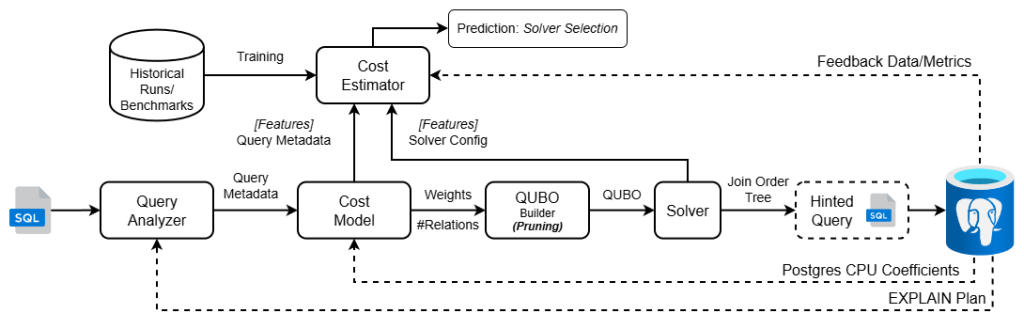
The “DEDALUS” project aims to redefine Join Order Optimization (JOO) as a hybrid quantum-classical optimization problem and demonstrate that quantum-inspired methods can produce competitive or superior execution plans on real database workloads.
JOO (Join Order Optimization) is inherently a combinatorial problem. The number of possible bushy join trees grows exponentially with the number of relations, while cost-based optimizers rely on imperfect cardinality estimates. The result is a search space that is both large and error-prone.
The project addresses this by transforming multi-way join enumeration into a structured Quadratic Unconstrained Binary Optimization (QUBO) problem and solving it using classical/quantum solvers. It encodes candidate join subsets as binary decision variables and constructs a QUBO objective whose energy landscape reflects database-aware cost semantics.
Statistics Extraction
- Extracts catalog statistics from PostgreSQL
- Synthesizes a multi-factor cost model incorporating cardinality, predicate cost, skew, and estimation uncertainty
Search Space Pruning
A central design principle of DEDALUS is the search space pruning. Structurally invalid or disconnected subsets are eliminated before binary encoding.
This:
- Reduces the number of logical variables (qubits)
- Lowers coupling density
- Improves embedding feasibility on annealers
- Reduces circuit width for gate-based algorithms
Solver Execution
DEDALUS integrates multiple solver backends within a unified pipeline, including:
- Classical simulated annealing (SA)
- Exact enumeration (for small instances)
- Gate-based algorithms such as QAOA
- Variational approaches such as VQE
- D-Wave’s quantum annealers suchs as, real QPUs and Hybrid Solving Systems
The framework is solver-agnostic, enabling controlled comparison between classical, simulated and real quantum execution.
Cost Estimation
The system integrates a Cost Estimator, a machine learning-based decision support system that recommends whether to execute join order optimization queries using classical, simulated or quantum solver.
Provides real-time recommendations before query execution, helping users:
- Avoid expensive quantum hardware misuse
- Identify queries where quantum solvers provide genuine benefit
- Learn query patterns over time
- Make informed decisions about solver selection
An End-to-End Executable Pipeline